In the aluminum coil processing industry, packaging not only protects the product's appearance but also directly impacts logistics efficiency, labor costs, and customer satisfaction. With the continuous development of automation technology, more and more companies are considering replacing traditional manual packaging with automated aluminum coil packaging lines. However, for many companies, whether to continue using manual packaging or invest in automated equipment remains a question requiring comprehensive evaluation.
In fact, neither packaging method is inherently superior or inferior; the key lies in the company's production scale, product characteristics, and future development plans.
The packaging processes differ
Manual packaging typically requires operators to sequentially complete multiple steps, including hoisting, positioning, wrapping with packaging materials, winding, strapping, labeling, and transferring. The entire process requires multiple people working together, and each step relies on the operator's experience; therefore, packaging speed and quality are easily affected by human factors.
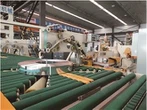
Automatic aluminum coil packaging lines integrate these processes into a continuous production line. After the aluminum coil enters the packaging area, it can sequentially complete processes such as automatic conveying, automatic positioning, weighing, winding, moisture-proof packaging, strapping, labeling, and even automatic palletizing. The various devices are linked through a PLC control system, reducing manual intervention and making the packaging process smoother.
For large aluminum processing companies requiring continuous production, this continuous operation method effectively reduces waiting time and keeps the packaging cycle synchronized with the upstream production line.
Production Efficiency Based on Automation
Production efficiency is a key factor for companies deciding whether to upgrade their packaging lines.
Manual packaging is often affected by factors such as operator skill level, team coordination, and workload. When orders increase, companies typically have to increase staff to boost capacity, which not only increases management complexity but is also susceptible to staff turnover.
Automated packaging lines, on the other hand, operate continuously according to preset programs, maintaining a stable packaging pace. For production lines requiring long operating hours, the equipment can continuously complete packaging tasks, maintaining relatively consistent work efficiency even in multi-shift production environments.
Furthermore, automated packaging lines reduce waiting time. For example, once one roll of aluminum is packaged, the next roll can immediately enter the packaging station without manual readjustment, significantly improving the overall production rhythm.
For companies with large daily packaging volumes, improved packaging efficiency not only benefits the packaging workshop but also prevents packaging from becoming a bottleneck in the entire production process.
Packaging Quality and Product Protection Capabilities
Aluminum coils have a relatively smooth surface, making them susceptible to scratches, dents, or moisture damage during transportation, loading, unloading, and warehousing. Therefore, packaging quality directly affects the final product delivery quality.
While manual packaging can meet basic protection needs, variations in packaging tension, number of wrapping layers, and strapping position, largely controlled manually, can occur between different operators. Inconsistent packaging tightness not only affects product appearance but can also lead to packaging loosening during transportation, increasing the risk of product damage.
Automated packaging lines, on the other hand, use programs to control various packaging parameters, such as wrapping tension, number of wrapping layers, overlap ratio, and steel strapping position, ensuring a relatively consistent packaging effect for each roll of product.
For export products, automated packaging lines can also be configured with multi-layer protection solutions according to customer requirements, such as:
- Moisture-proof paper packaging
- PE stretch film wrapping
- Kraft paper protection
- VCI anti-corrosion material
- Edge corner protection
- Steel strapping or PET strapping fixation
This standardized packaging method not only helps reduce transportation losses but also enhances customer satisfaction with product packaging quality.
Labor costs and long-term operating costs
Many companies prioritize price when purchasing packaging equipment, neglecting long-term operating costs.
Manual packaging has the advantage of lower initial investment, but as production scales up, companies need to continuously increase packaging staff, incurring costs for wages, training, management, and staff turnover. Especially with rising labor costs, labor expenditures in the packaging process often increase year by year.
While automated packaging lines require some initial investment, their long-term value lies not only in reducing the number of workers but also in:
- Reducing packaging material waste
- Reducing rework due to non-standard packaging
- Reducing transportation damage rates
- Improving production continuity
- Reducing downtime
Therefore, for companies with stable orders and large production capacity, automated equipment often offers a better long-term return on investment.
Main Components of an Automated Aluminum Coil Packaging Line
A complete automated aluminum coil packaging line is typically not a single piece of equipment, but rather composed of multiple functional modules that work together to complete the entire packaging process.
Common components include:
- An automatic conveying system for transporting aluminum coils to each workstation.
- An automatic positioning device to ensure the aluminum coils are placed in the correct packaging position.
- A wrapping machine for uniform and efficient wrapping with packaging materials.
- A tape-applying system to secure the packaged aluminum coils.
- An automatic labeling system for automatic printing and affixing of product information.
- An automatic weighing system for convenient product outgoing management.
- A PLC control system and HMI user interface for automated line operation and parameter management.
Depending on company needs, functions such as automatic coil turning, online inspection, robotic palletizing, and AGV automated handling can be added to further enhance the intelligence of the entire production line.
Which companies are best suited for automated packaging lines?
Not all companies need to build a fully automated packaging line from the outset. Different production scales require different solutions.
For companies with small order volumes and frequently changing product specifications, manual packaging or semi-automatic equipment can meet daily production needs while controlling initial investment costs.
For medium-sized companies that need to package large quantities of aluminum coils daily with relatively fixed product specifications, a combination of semi-automatic and automated equipment can be considered, gradually increasing automation levels while controlling budget.
For large aluminum processing companies, export-oriented companies, or continuous production companies, fully automated packaging lines are more advantageous. Stable packaging cycles, standardized packaging, and lower reliance on manual labor help companies maintain long-term stable operation and meet customers' consistent packaging quality requirements
When Should You Consider Upgrading to an Automated Packaging Line?
Many companies face this question: when is the right time to invest in an automated packaging line?
Generally, it's worth carefully evaluating an automation upgrade plan when the following situations occur:
- Packaging worker costs are continuously rising, and recruitment is becoming increasingly difficult.
- The packaging process is beginning to affect the overall production line's cycle time.
- Product specifications are becoming increasingly standardized, suitable for continuous production.
- Export orders are increasing, demanding higher packaging quality and protection.
- Customers are requiring standardized packaging or traceability management.
- The company plans to expand production and wants to reduce future redundant investment.
If a company is experiencing one or more of these situations, it indicates that the packaging process has become a significant factor affecting production efficiency, and introducing an automated packaging line can usually bring more significant improvements.
Conclusion
Manual packaging and automated aluminum coil packaging lines each have their applicable scenarios, and no single solution can meet the needs of all businesses. When choosing a solution, companies should comprehensively consider production scale, product specifications, labor costs, packaging quality requirements, and future development plans, rather than simply comparing equipment purchase costs. Selecting a packaging solution suitable for your own production model is crucial to ensuring product quality while improving production efficiency and market competitiveness.
If you are planning or upgrading your aluminum coil packaging line, please contact Jinglin Packaging. We can provide professional automated packaging solutions based on your aluminum coil specifications, production capacity, packaging requirements, and factory layout, helping you optimize your packaging processes, improve production efficiency, and provide reliable support for your future development.