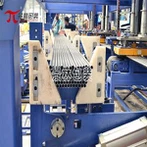
Why does the coil packaging line need maintenance?
In the processing and logistics system of modern metal materials such as steel coils, copper coils, and aluminum coils, the coil packaging line is not only the endpoint of the packaging process, but also the "last quality checkpoint" before products enter the market.The coil packaging line system covers multiple complex process steps such as unloading, centering, winding, wrapping, weighing, labeling, and palletizing, with frequent daily operation, precise structure, and strong systematicity.
If there is a lack of scientific maintenance, the following problems are prone to occur:
● Frequent malfunctions affecting production capacity and delivery time
● The cost of spare parts consumption has increased, and maintenance manpower is difficult to control
● Key components are aging prematurely, resulting in a shortened overall lifespan of the equipment
● Unqualified product packaging leads to transportation losses and brand risks

Daily maintenance operations
Frequency suggestion: Before work every day+after each device shutdown
This type of inspection is carried out by equipment operators, with a focus on timely detection of abnormal symptoms and avoiding the amplification of potential hazards:
Inspection items:
● Main power and gas supply system: Confirm whether the voltage, current, and air pressure are stable and have no abnormal fluctuations.
● Status of moving parts: Check whether the belt, chain, bearing, and slide rail are loose, stuck, dry, or asymmetrically worn.
● Winding and film material mechanism: Check whether the winding arm moves smoothly, whether the sensitivity of the tension adjustment device is normal, and whether the film roll is deformed.
● Sensors and photoelectric components: Test the sensitivity of the detector with a manual switch to check for dust or obstruction.
● Control panel response: operate start/stop/manual functions, confirm that touch screen/button response is timely, without lag or error feedback.
● Security system: including safety light barriers, emergency stop buttons, warning lights, and buzzers must be fully functional and effective.
Tool suggestion:
● Equipped with simple tools such as cleaning brushes, air guns, and wiping cloths for quick daily maintenance.
● Use digital inspection forms to record daily maintenance results and create traceability documents.
Regular maintenance system
Weekly maintenance points:
● Clean the equipment casing and moving parts to prevent the accumulation of metal dust.
● Tighten moving and stationary components, such as brackets, base plates, cylinder fixing points, etc.
● Check the equipment alignment system to ensure that the coil feed path is consistent with the packaging positioning and prevent misalignment.
● Check the operation trajectory of all rollers and capsule arms. If there is any abnormal noise or synchronization, it should be immediately investigated.
Monthly maintenance points:
● Replace or add lubricating grease to guide rails, rollers, gearboxes, and cylinders.
● Check whether the switch power supply, relay, and contactor are overheating or aging, and whether the cable terminal screws are loose.
● Review the mechanical accuracy of the tensioning mechanism and the guide system of the tape guide.
● Re calibrate the positioning sensor/barcode reading device to maintain accuracy.
Quarterly maintenance focus:
● Conduct a no-load operation test on the entire line to check if all submodule interlocking actions are smooth.
● Clean and inspect all modules inside the electrical control box, remove static dust, and check the grounding circuit.
● Verify the versions of the main PLC and HMI programs, and backup the operating parameters.
● Assess whether some vulnerable parts need to be purchased in advance based on the cumulative operating time.
Annual major maintenance:
● PLC system diagnosis and program optimization: detect I/O response speed, update human-machine interface HMI function menu.
● Structural component precision adjustment: Use a laser alignment instrument to correct the installation deviation of the alignment guide rail and drive system.
● Disassembly and inspection of bearings, reducers, and guide components: replace transmission components with abnormal wear.
● Debugging of servo and variable frequency control system: Optimize acceleration and deceleration curves to improve smooth operation.
● Energy consumption statistics and optimization suggestions: Evaluate the annual power consumption situation and propose energy-saving renovation plans (such as replacing stepper motors with servos).
Fault warning and rapid troubleshooting system
The common types of problems are as follows:
|
Fault phenomenon |
Potential reasons |
Quick troubleshooting suggestions |
|
Misplaced packaging or wrinkled film |
Insufficient packaging tension, tape deviation, and abnormal noise from the winding arm |
Re tension the guide belt, replace the tension spring, and check the motor bearings |
|
The system does not start |
Safety photoelectric not closed, PLC stuck, contactor damaged |
Restart PLC, reset safety circuit, check I/O module |
|
Automatic feeding failed |
Damaged feeding motor, encoder malfunction, signal interruption |
Check the motor driver, replace the encoder, and verify the PLC logic |
|
local overheating |
Fan stalling, frequency converter overload, power module overheating |
Replace the fan, install ventilation holes, and replace the derating components |
|
Suggest combining visual status panels with sound and light alarms to improve on-site problem response speed. |
||
Maintenance Schedule for Roll Packaging Line (2025 Edition)
|
Maintain the project |
Suggested frequency |
Responsible personnel |
Inspection methods/tools |
Remarks/Objectives |
|
Check the power supply voltage and air pressure |
Daily (before startup) |
Equipment operator |
Multimeter, Barometer |
Ensure stable operating conditions before system startup |
|
Check the wear status of the conveyor belt and rollers |
daily |
Equipment operator |
Visual inspection, manual rotation |
Prevent slipping during transportation or damage to the coil during transportation |
|
Clean the dust on the sensors and photoelectric eyes |
daily |
Equipment operator |
Brush, wiping cloth |
Maintain detection accuracy and prevent misjudgment |
|
Check the tension device of the wrapping film |
daily |
Equipment operator |
Manual tensile testing |
Prevent film wrinkling, loose wrapping, and insufficient tension |
|
Check the emergency stop button and safety light barrier |
daily |
Equipment operator |
Button testing and sensor alignment inspection |
Ensure personal and equipment safety |
|
Add lubricating grease to the guide rail and linear bearing |
every week |
Maintenance technician |
Lubrication gun, lithium based grease |
Reduce mechanical friction and eliminate noise |
|
Tighten bolts of vibration prone components |
every week |
Maintenance technician |
Torque wrench |
Prevent structural loosening caused by long-term vibration |
|
Clean the ventilation system of the control cabinet |
every week |
Maintenance technician |
Air gun, dry cloth |
Avoid overheating of electronic control components caused by dust |
|
Calibrate the positioning sensor |
monthly |
Automation engineer |
Specialized calibration tools, software interface |
Ensure accurate alignment of the coil and the position of the envelope |
|
Check if the tension spring has failed |
monthly |
Maintenance technician |
Spring tension meter |
Maintain packaging tension within the set range of the equipment |
|
Check PLC input/output response and delay |
every quarter |
Automation engineer |
Industrial control laptop, PLC software |
Optimize signal stability and instruction execution efficiency |
|
Replace worn parts (belts, seals, bearings, etc.) |
every quarter |
Maintenance technician |
Original spare parts, dismantling and inspection |
Prevent sudden shutdowns and extend equipment lifespan |
|
Repair the winding arm and rotating component |
every year |
Original factory engineer or certification team |
Complete disassembly, measurement, and positioning calibration |
Restore torque balance and ensure structural stability during high-frequency operation |
|
Backup PLC and HMI operating programs |
every year |
Automation engineer |
USB/Cloud Backup |
Prevent system data loss and facilitate fault recovery |
|
Full line no-load trial operation+operation data recording and analysis |
every year |
Maintenance supervisor |
Vibration tester, operation log system |
Detecting linkage logic and system coordination |
|
Analyze annual energy consumption data and propose energy-saving suggestions |
every year |
Energy Efficiency Specialist/Original Factory Consultant |
Electric energy meter, energy-saving analysis software |
Explore the potential for energy conservation and assist in green manufacturing |
Conclusion
The maintenance and upkeep of the coil packaging line is a necessary process to ensure the normal operation of the equipment and extend its lifespan.Whether it is lubrication inspection of the chain drive system, periodic testing of the electronic control module, or regular maintenance of dust prevention and safety protection mechanisms, as long as a reasonable maintenance plan is formulated and implemented properly, the operational stability and service life of the equipment can be significantly improved.
If you need to replace the one-stop roll packaging line, please feel free to contact us - Jinglin. We have 30 years of experience in designing automated packaging systems and are committed to providing customers with professional, efficient, and reliable solutions.Contact us now to create a smarter and more efficient packaging production.