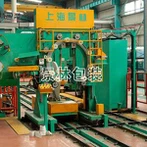
In the aluminum processing industry, packaging is often underestimated, but its impact on product quality, transportation safety, and customer satisfaction is very direct. Especially the final step before aluminum coils leave the factory-the choice of packaging method-often determines the stability and risk level in subsequent distribution stages. Currently, the two mainstream solutions are horizontal and vertical aluminum coil packaging lines. The different designs are not simply structural differences, but are closely related to production rhythm, product specifications, and logistics methods.
What is a horizontal aluminum coil packaging line?
Horizontal packaging refers to the process where aluminum coils are kept horizontal throughout the packaging process, meaning the core direction is parallel to the ground. The equipment typically uses a linear layout around this orientation, with each station operating in the same direction from feeding and conveying to winding and strapping, forming a continuous operational path.
In practical applications, horizontal packaging is easier to seamlessly integrate with slitting lines or winding equipment. Aluminum coils can enter the packaging stage without changing their orientation after leaving the line. This process simplifies intermediate steps and helps maintain a stable production rhythm. For companies primarily engaged in mass production, this method offers advantages in terms of efficiency and system stability.
From a process perspective, horizontal packaging emphasizes overall coverage and continuous processing, making it suitable for multi-layer winding, moisture protection, and other operations. It is currently a widely used packaging method.
What is a vertical aluminum coil packaging line?
Vertical packaging processes aluminum coils in a "vertical" position, meaning the core is perpendicular to the ground. Before entering the packaging station, the aluminum coil is typically turned from a horizontal to a vertical position using a flipping device, followed by subsequent fixing, protection, and packaging operations.
Due to the change in posture, the structural design of a vertical packaging line requires a focus on support stability and clamping accuracy to ensure the coil remains balanced throughout the process, without shifting or tilting. Simultaneously, the equipment layout is more modular, with each station functionally allocated around the vertical orientation.
In terms of application, vertical packaging is more advantageous for protecting edges and ends, making it particularly suitable for products with high surface quality requirements or those requiring meticulous storage management. Compared to horizontal solutions, it places greater emphasis on the quality of single-coil processing and the convenience of back-end management.
Production Efficiency and Process Integration
In production line planning, the packaging section is often at the end, but its impact on overall efficiency is very direct. Especially in high-capacity rolling or slitting production, any mismatch in cycle time can lead to backlog at the front.
The advantage of a horizontal packaging line lies primarily in the fact that it "does not require changing the material's posture." After exiting the winding machine, aluminum coils can directly enter the packaging area via roller conveyors, with almost no interruption in the entire process. This mode has several distinct characteristics:
- Strong process continuity, suitable for long-term stable operation
- Relatively simple cycle time control, easy to automate
- Low equipment changeover costs when processing multiple coils continuously
In contrast, vertical packaging usually requires an additional critical step-flipping. While this step can be automated at the equipment level, it still requires meticulous design in cycle time control; otherwise, it can easily become a bottleneck.
However, vertical solutions are more suitable for the following scenarios:
- Multiple specifications, small batch orders
- High requirements for single-roll processing accuracy
- Requirement for independent workstation operation rather than continuous flow operation
Therefore, horizontal solutions are more inclined towards: production line efficiency, while vertical solutions are more inclined towards: unitized processing quality.
Comparison of Packaging Protection Effects
The risks to aluminum coils during distribution typically focus on a few specific issues: scratches, dents, and moisture damage. Whether these problems occur largely depends on the packaging method's ability to control stress and environmental conditions.
Horizontal packaging offers the advantage of overall coverage. Because the coil is unfolded laterally, equipment can continuously wrap it in multiple layers, forming a relatively complete protective structure. This method is particularly suitable for the following needs:
- Large-area surface protection
- Shock cushioning during long-distance transportation
- Layered use of multiple moisture-proof materials
However, it's important to note that horizontal aluminum coils may face a hidden problem when stacked: the pressure from above can be transmitted to the edges through the support points. If the support design is insufficient, slight edge deformation can easily occur.
Vertical packaging addresses this issue from another perspective. Because the coil is upright, the edges no longer bear vertical pressure, which is especially crucial for high-end surface-treated products (such as coated aluminum coils). Meanwhile, the vertical structure makes it easier to reinforce and protect the end faces, for example:
- Adding end face guards or anti-collision structures
- Improving edge impact resistance
- Reducing localized contact during handling
Regarding moisture protection, both methods can control moisture through materials, but the vertical configuration is less prone to localized water accumulation or condensation points in certain storage environments, which is more pronounced in areas with high humidity.
Equipment Investment and Maintenance Costs
At the equipment investment level, the difference between horizontal and vertical packaging lines lies not only in price but also in system complexity and subsequent maintenance methods.
Horizontal packaging lines typically employ a more mature modular structure, with common configurations including conveyor rollers, circular winding machines, and belt wrapping devices. The advantages of this structure are:
- Greater equipment selection options, allowing for flexible configuration based on budget.
- Relatively controllable installation and commissioning cycles.
- Maintenance primarily involves routine mechanical upkeep, with lower technical barriers.
Therefore, for companies seeking stable output and reduced uncertainty, horizontal solutions are easier to implement.
Vertical packaging lines, on the other hand, are systems with a higher degree of customization. Their core challenges lie in the three stages of flipping, positioning, and clamping, which require high precision and control logic. The corresponding characteristics are:
- Relatively higher initial investment.
- Commissioning relies more heavily on experience and technical support.
- Subsequent maintenance requires more specialized personnel.
However, from a long-term operational perspective, the value of vertical packaging in reducing product loss and improving quality consistency can be amplified in certain high-end applications.
How to Make a More Suitable Choice
In the actual decision-making process, judging solely by the quality of equipment is often meaningless; the key is the degree of matching. A more effective approach is to gradually filter through several core dimensions:
Horizontal packaging can be prioritized for:
- Fast production pace, emphasizing continuous and high efficiency
- Relatively uniform product specifications, low changeover frequency
- Transportation mainly involves long-distance, standardized logistics
Vertical packaging is more suitable for:
- High requirements for surface or edge quality
- High product added value, requiring reduced losses
- Warehouse management emphasizes precision and traceability
In addition, the following practical factors should be considered for comprehensive judgment:
- Whether the existing production line layout is easy to modify
- The proportion of logistics methods (domestic sales/export)
- The customer's specific requirements for packaging form
Ultimately, the most reasonable choice is not a certain "universal solution," but rather finding a balance between production processes, equipment capabilities, and logistics conditions. Only when these three form a synergistic relationship can the packaging system truly realize its value, rather than merely completing "a process before leaving the factory."
Conclusion
Horizontal and vertical aluminum coil packaging lines each have their applicable boundaries; essentially, they are two solutions tailored to different production logics. Only by fully understanding one's own process characteristics and customer needs can a more rational configuration be chosen, thereby improving overall operational efficiency while ensuring product quality.
If you are evaluating or upgrading your aluminum coil packaging system, we recommend system planning based on your actual application. Jinglin Packaging specializes in the research and development and customization of metal coil packaging equipment, and can provide solutions more tailored to the specific needs of different production lines. Please contact our engineers to select the appropriate packaging equipment.