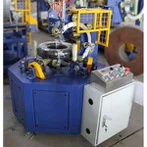
In the hose manufacturing industry, companies often focus more on extrusion formulas, mold precision, or production speed, but tend to overlook a seemingly "auxiliary" aspect-the post-production handling and shaping of the hoses. In fact, extensive production experience shows that the way hoses are coiled and secured after production directly impacts subsequent handling efficiency, warehousing management, and even the final appearance quality.
When hoses cannot be stably and regularly coiled into coils after extrusion, problems such as loose coiling, tangling, and localized deformation can occur. These problems are not simply due to operational errors, but are the inevitable result of faster production cycles and the inability of manual handling to keep up. It is precisely because of this need that the Hose Wrapping Machine has gradually evolved from an "optional equipment" to an indispensable component in modern hose production lines.
Compared with traditional manual coiling methods, the value of the Hose Wrapping Machine is not only reflected in improved efficiency, but also in the systematic improvement of the consistency of hose shaping and the controllability of the process.
What is a Hose Wrapping Machine?
Hose Wrapping Machine is an industrial device used to automatically coil hoses into standard coils during the production or finishing stage, maintaining their stable shape through winding or securing methods. It does not perform the final packaging function, but rather focuses on solving the problem of "how to properly organize and shape" the hoses after production.
After continuous extrusion or cutting, hoses are often still in a flexible state. If they are not coiled promptly and stably, they are prone to rebounding, misalignment, or inconsistent coil diameters. The Hose Wrapping Machine precisely controls the coil diameter, rotation speed, and winding tension, allowing the hose to be formed in the most suitable state, thus creating coils with a uniform structure and consistent dimensions.
From a process perspective, the Hose Wrapping Machine is more like a "shaping control unit" in the production line. It transforms the sorting process, which was previously highly dependent on manual experience, into parameterizable and repeatable mechanical actions, creating stable conditions for subsequent handling, storage, and the next process.

Hose Wrapping Machine Working Principle
The core purpose of the Hose Wrapping Machine is to stably and uniformly wind hoses into coils during the production phase, ensuring efficiency in subsequent processes and product quality. The working principle and process are generally similar and can be divided into the following key stages:
1. Automatic Feeding and Tension Control
When the hose enters the wrapping machine from extrusion, cutting, or previous processes, it first passes through guide rollers or pulley systems to maintain the correct path.
- The tension control system ensures that the hose maintains constant tension throughout the winding process, preventing loosening or stretching deformation.
- High-end equipment is usually equipped with photoelectric detection or tension sensors to adjust the feeding speed and angle in real time, ensuring consistency for each coil of hose.
2. Coil Forming
Coil forming is the core function of the Wrapping Machine. It uses a rotating disc, swing arm, or combination mechanism to uniformly wind the hose into a coil according to the set diameter:
- Rotating disc type: The hose is fixed on the central axis, and the coil is formed by the rotation of the disc. Suitable for large-volume standard diameter hoses.
- Swing arm type: The hose forms a coil through a reciprocating swing arm or track, which is more suitable for production lines with multiple specifications and frequent changes.
- Spiral guidance: Ensures that the hoses do not overlap or cross each other during the winding process, improving the neatness of the coil.
The equipment usually allows adjustment of the coil diameter, number of turns, and interlayer spacing to adapt to the needs of hoses of different diameters and lengths.
3. Wrapping and Fixing
To maintain the stability of the coil shape, the equipment uses various methods to fix the hose:
- Plastic film wrapping: Protects the outer layer of the hose and prevents unraveling.
- Strapping tape or nylon cable ties: Quickly fixes the coil shape, suitable for harder or larger diameter hoses.
- Automatic tightening device: Automatically adjusts the winding tightness according to the elasticity of the hose to prevent deformation or indentations.
High-end equipment also combines multi-point pressing or rotating tension arms to ensure uniform coil shape and tight layers.
4. Coil Measurement and Quality Inspection
Modern Hose Wrapping Machines are often equipped with length measurement, diameter correction, and coil shape monitoring systems:
- Ensures that the length of each coil of hose is consistent with the specifications. • Detects deviations in coil diameter or uneven winding, and automatically triggers an alarm or rejects the product if necessary.
- Can be integrated with the production line PLC system for production data tracking, facilitating quality control and report management.
5. Hose Coil Output and Connection to the Next Process
After winding is complete, the hose coil is automatically moved to a pallet or conveyor system, ready for the next process (such as finished product cutting, packaging, or warehousing).
- The equipment usually features buffer slides or automatic lifting platforms to prevent the coil from loosening or deforming during transfer.
- Can be directly linked with conveying, packaging, or stacking systems to achieve a fully automated production line.
The core principle of the hose wrapping machine involves not only the winding action itself, but also tension control, winding diameter adjustment, fixing methods, and quality monitoring. Each of these aspects directly affects the dimensional stability and production efficiency of the hose, making it an indispensable part of automated hose production lines.

Why is winding quality so crucial?
In hose production, winding quality directly impacts the efficiency of the entire production process and the final performance of the hose. Loose, uneven, or overly tight winding can lead to the following problems:
Affects storage and transportation efficiency
Irregularly wound hose coils are difficult to stack neatly, occupying more storage space and increasing storage costs. They are also more prone to unraveling, friction damage, or crushing during transportation.
Affects subsequent automated processes
Modern production lines are often equipped with automatic packaging or handling equipment. If the winding is irregular, the hose may not be able to enter the conveying system smoothly, leading to frequent equipment downtime or rework.
Affects hose performance and service life
Overly tight winding can generate localized stress, leading to hose deformation or even micro-cracks; overly loose winding makes the hose prone to unraveling during handling or storage, increasing the risk of bending and wear.
Affects production efficiency and cost control
Inconsistent winding of each hose coil can lead to repetitive operations, manual intervention, or rewinding, wasting manpower and production time, and increasing material loss.
Affects product standardization and customer experience
For enterprise customers, the neatness and stability of the hose coils directly affect their warehouse management and ease of use. Poor winding can negatively impact the customer's overall perception of product quality.
Therefore, high-quality winding is not only a guarantee of efficiency in the production process, but also a key factor in ensuring hose performance, reducing costs, and improving customer satisfaction. By using advanced Hose Wrapping Machines, it is possible to ensure that each hose coil is uniform in size and stable in structure, laying a solid foundation for subsequent packaging and transportation.
Requirements for Different Hoses Regarding Winding Methods
Not all hoses are suitable for the same winding method; specific requirements vary significantly depending on the material, diameter, wall thickness, and flexibility:
Differences in Hose Materials
- PVC hoses: Moderate flexibility and high resilience. Tension should not be excessive during coiling, otherwise kinking and deformation may occur.
- Rubber hoses: Soft and highly elastic. Even tension is required during coiling; otherwise, the coil diameter may be inconsistent, affecting subsequent handling and automated conveying.
- PU hoses: Smooth and relatively soft. Anti-slip guiding devices or slight tension should be used during winding to prevent slipping or loosening.
- Composite hoses (such as steel wire reinforced or multi-layered structures): Higher rigidity. A larger coil diameter is required during winding to prevent excessive bending of the hose, which could lead to internal layer separation or damage.
Hose Diameter and Wall Thickness
- Large diameter/thick-walled hoses: Due to increased volume and weight, higher support force and stronger winding machinery are required; otherwise, the coil may be unstable or irregularly shaped.
- Small diameter/thin-walled hoses: Easily stretched or flattened. Lower tension and even winding are required, while avoiding excessive tightness at the winding center.
Length and Number of Coils Requirements
- Longer hoses require higher uniformity in coiling. Excessively long single coils can easily lead to loose cores or outer layer slippage.
- Production lines usually set the number of coils or winding turns based on the hose length to ensure consistent coil diameter, facilitating storage and subsequent processing.
Special Requirements
- Anti-indentation: Some high-end hoses are prone to surface indentations. Buffering measures or flexible straps should be added during winding.
- Multi-diameter compatibility: Multi-model production lines require Hose Wrapping Machines that support quick adjustment of coil diameter and tension parameters to handle different hose specifications.
By scientifically selecting the winding method and equipment parameters, it is possible to ensure that each coil of hose maintains a stable shape and consistent size during the production stage, laying a solid foundation for subsequent operations and transportation.
Advantages of Automatic Hose Wrapping Machines
Compared to manual or semi-automatic methods, automatic hose wrapping machines demonstrate significant advantages in hose production and finishing:
High Consistency and Precision
Automatic equipment can precisely control the coil diameter, winding tension, and number of turns according to set parameters, ensuring high uniformity in the shape, tightness, and weight of each hose coil. For hoses that need to enter subsequent automatic conveying or packaging lines, this consistency significantly reduces rework and logistics problems.
Significantly Reduced Labor Costs and Operational Complexity
One automatic winding machine can typically replace 2–3 manual operators, especially in the handling of long or large-diameter hoses. Furthermore, operators only need to set equipment parameters and perform simple monitoring, greatly reducing the reliance on skilled workers.
Increased Production Efficiency and Capacity
Automatic winding speed can be flexibly adjusted according to hose specifications, and it supports continuous production mode. Compared to manual winding, output can be increased by 50%–100%, making it particularly suitable for companies with large-volume production or high-frequency orders.
Reduced Hose Damage and Quality Risks
The machine's uniform winding and stable tension control effectively prevent twisting, creases, or local deformation caused by manual winding, maintaining the original physical properties of the hose and improving the overall quality of the finished product.
Easy Integration and Future Expansion
Automatic hose wrapping machines can be seamlessly integrated with extrusion lines, cutting equipment, and conveying systems to form a closed-loop production line. Some high-end models also support parameter storage, remote monitoring, and multi-specification switching, facilitating future production upgrades and capacity expansion for factories.
Suitable for Various Hose Materials and Specifications
Automatic equipment typically supports hoses of different materials such as PVC, rubber, and PU, and can adjust the winding method, coil diameter, and fixing method to meet the production needs of diverse product lines.
How to Choose the Right Hose Wrapping Machine
When selecting a machine, companies typically need to focus on:
- Applicable hose diameter and material range
- Whether the coil diameter and winding method are adjustable
- Whether it supports continuous production
- Whether it is easy to maintain and adjust parameters
- Whether it can be integrated with existing production lines
- The winding speed and tension control accuracy of the equipment
- Footprint and layout flexibility
A well-designed Hose Wrapping Machine not only increases speed but also helps companies transform operations that previously relied on experience into reproducible and controllable standardized processes.
Jinglin Packaging specializes in the research, development, and manufacturing of equipment related to hose winding and finishing. We can provide more suitable Hose Wrapping solutions based on different hose materials, diameters, and production rhythms. If you are evaluating the winding efficiency of your existing production line or planning to introduce more stable automated equipment, please contact Jinglin Packaging for equipment recommendations and technical support tailored to your specific working conditions.