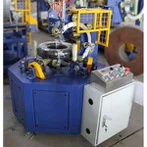
In the pipe manufacturing industry, packaging is not merely a step before shipment but a critical process that enhances delivery efficiency, protects product integrity, and showcases brand image. The pipe packaging line, as a key automated packaging system, has become an indispensable equipment for pipe enterprises due to its advantages of high efficiency, low labor dependency, and customizability. Whether for plastic pipes, metal pipes, or composite industrial pipes, an efficient and stable packaging system not only affects the final delivery quality of products but also directly impacts overall production rhythm and customer satisfaction.
What is a Pipe Packaging Line?
A pipe packaging line refers to an automated packaging operation system that automatically guides formed pipes from the production end to the packaging end, undergoing processes such as alignment, bundling, packaging, and marking to achieve efficient, standardized, and continuous automated packaging operations. Its purpose is not only to reduce manual input but also to ensure product appearance consistency and transportation safety.
A pipe packaging line typically includes the following key modules:
- Conveying System: Uses rollers, belts, or chain conveyors to automatically connect extrusion or cutting lines, enabling stable transfer.
- Automatic Alignment and Arrangement Device: Arranges and positions pipes of different lengths/calibers to improve packaging consistency.
- Intelligent Bundling Module: Employs automatic bundling machines for high-tension bundling, with options for plastic steel straps, PP straps, or heat-melt straps.
- Packaging System: Provides various forms such as film wrapping, bagging, or shrink film encapsulation to protect products from dust, moisture, and other contaminants.
- Labeling and Identification System: Supports multiple identification methods, including inkjet printing, QR code printing, and automatic labeling of logistics barcodes.
- Finished Product Offline and Stacking System: Can interface with automatic palletizers or forklift interfaces to achieve seamless shipment processes.
The entire system not only enhances efficiency but also enables data exchange with the enterprise's WMS (Warehouse Management System) and MES (Manufacturing Execution System), laying the foundation for smart manufacturing.

Classification and Applicable Scenarios of Pipe Packaging Lines
Based on different usage scenarios and capacity requirements, pipe packaging lines can be mainly classified into the following categories:
By Automation Level:
- Fully Automated Packaging Line: Suitable for large-scale production enterprises with frequent orders and high rhythm requirements.
- Semi-Automated Packaging Line: Commonly used in medium-sized factories and small-to-medium enterprises with limited budgets and moderate output.
- Modular Combination Type: Allows flexible combination of packaging methods to adapt to frequent changes in project or order types.
By Packaging Object:
- Plastic Pipes (e.g., PVC, PPR, PE): Require higher surface protection and aesthetic appeal, suitable for film wrapping or bagging.
- Metal Pipes (e.g., Galvanized Pipes, Stainless Steel Pipes): Heavier, requiring reinforced bundling devices and wear-resistant packaging materials.
- Composite Pipes or Special-Shaped Pipes: Require custom-designed clamping and buffer structures to prevent damage to their shape.
By Packaging Method:
- Bundling Packaging: Fast and convenient, suitable for batch shipments.
- Film Wrapping/Shrink Film Packaging: Provides a certain degree of sealing, suitable for outdoor storage or export.
- Packaging + Labeling Integration: Suitable for export, logistics tracking, and internal factory information management.


Core Advantages of Pipe Packaging Lines
- Improves Production Efficiency: Traditional manual packaging is time-consuming and unstable in efficiency, while automated systems can operate continuously, significantly increasing capacity. For example, a fully automated PVC pipe packaging line can process thousands of pipes per hour, far exceeding manual limits.
- Reduces Labor Costs: Through structural optimization, pipe packaging lines can significantly reduce labor allocation in the packaging process, offering greater advantages amid rising labor costs.
- Reduces Packaging Errors and Material Waste: Automated packaging systems offer high repeatability precision, with controllable bundling tension and arrangement spacing, greatly minimizing packaging errors and material loss.
- Lowers Error Rates and Return Rates: Issues such as inconsistent pipe lengths, mixed packaging, and missed bundling are common defects in traditional packaging. Automated systems can automatically identify and alert anomalies through sensing, length measurement, and inspection modules.

How to Choose the Right Pipe Packaging Line?
- Pipe Specifications and Type: Clarify the product's diameter range, length, and tolerance requirements to determine the alignment method and bundling solution.
- Automation Level Requirements: Determine whether full-process unmanned operation is needed and whether integration with upstream and downstream equipment is required, which influences the choice between fully automated and semi-automated systems.
- Factory Space and Layout: Plan the production line flow based on the actual site, determining layouts such as left-in-right-out, right-in-left-out, L-shaped, or U-shaped structures.
- Packaging Materials and Environmental Requirements: Consider whether eco-friendly film wrapping is needed, whether recyclable bundling straps are required, and whether there are regulatory requirements for materials in certain markets (e.g., the EU).
- After-Sales Service Support System: Ensure the provider offers on-site installation and debugging, fault diagnosis services, and guarantees stable operation after delivery.
A pipe packaging line is not just a single packaging equipment; it is a critical system for building the future smart factory and transparent production system. Through it, production can become more streamlined, packaging more professional, customers more satisfied, and the brand more unified.
If you are considering automating your packaging process or wish to customize an efficient pipe packaging line solution based on your product characteristics, feel free to contact Jinglin Packaging. With years of industry experience, we offer one-stop packaging automation solutions-from needs analysis, solution design, non-standard customization, to after-sales support-helping your enterprise complete the crucial upgrade from traditional packaging to smart packaging!