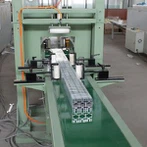
In industries such as copper processing, refrigeration, and cable manufacturing, copper coils typically enter the distribution chain as high-value products with stringent surface quality requirements. Compared to the production process itself, the packaging stage for copper materials is often underestimated; yet, in reality, the majority of transit-related damage and customer complaints stem from issues occurring during the packaging phase or from flaws in packaging design.
In recent years, as factories have undergone modernization upgrades, an increasing number of enterprises have begun adopting automated copper coil packaging lines to replace traditional manual methods. However, despite this shift, packaging-related issues continue to arise frequently. This indicates that the problem lies not solely with the equipment itself, but also involves the proper alignment of operational processes and the overall design of the packaging solution.
This article will provide a detailed breakdown of the common challenges encountered during the copper coil packaging process, along with practical solutions to address them.
Scratches or Indentations on the Surface of the Copper Coil
Scratches and indentations are the most common issues-and those that most directly impact customer acceptance-particularly in industries with stringent surface quality requirements (such as refrigeration and precision tubing), where such defects frequently result in the rejection of entire batches.
Common Causes:
- Inappropriate packaging material hardness or a lack of cushioning layers.
- Direct contact between coils or improper stacking arrangements.
- Friction or misalignment occurring during the operation of packaging machinery.
- Unstable control of winding tension, resulting in excessive localized pressure.
In certain automated environments, if the guiding mechanism of an automated copper coil packaging line lacks sufficient precision-or if the copper coil exhibits slight wobbling during rotation-"repetitive friction points" may form during the wrapping process, thereby causing circular scratches.
Approach to Solution
First, the structure of the contact interface must be optimized to avoid "hard contact." Second, during the operation of the copper coil packaging machine, the focus should be placed on guide stability and the tension profile, rather than on the adjustment of isolated parameters.
A stable operational trajectory is more effective than simply reducing tension, as many scratches result from "continuous friction" rather than from a single instance of compressive damage.
Loosened or deformed during transit
This issue frequently manifests in concentrated outbreaks during long-distance transport or export orders-particularly in maritime shipping environments-where vibration, humidity, and stacking pressure serve to amplify packaging defects.
Common Causes
- The strapping configuration fails to establish an effective load-bearing structure (serving merely to "bundle" rather than to "secure" the load).
- The wrapping material lacks sufficient elasticity and gradually loosens during transit.
- The pallet or base structure possesses inadequate load-bearing capacity.
- Potential multi-directional impacts (both lateral and longitudinal) were not taken into account.
If copper coil packaging equipment is designed solely to address "factory-gate conditions" without simulating actual transport scenarios, the packaging-even if it appears secure on-site-is highly susceptible to failure during the logistics process.
Proposed Solutions
The packaging structure must possess dynamic resilience rather than merely satisfying the requirements of static storage. It is recommended that a transport-simulation mindset be integrated into the design phase of the copper coil packaging system-for instance, by verifying whether the strapping paths form a closed load-bearing loop and ensuring that critical points are adequately supported.
In practical application, structural stability should be prioritized over material thickness-a critical point that many enterprises frequently overlook.
Inefficient Packaging and Heavy Reliance on Manual Labor
This issue is highly typical among medium-sized manufacturing enterprises; in particular, when order volumes fluctuate significantly, manual packaging struggles to maintain a consistent pace.
Common Issues
- Packaging cycle times are significantly influenced by operator proficiency.
- There are substantial variations in quality between different work shifts.
- Manual handling creates an increased risk of product damage.
- It is difficult to rapidly scale up production during peak periods.
Although many companies have introduced automated equipment, they often remain stuck in the "single-machine-replacing-manual-labor" stage, failing to achieve true synergy across the production line.
Proposed Solutions
The key to boosting efficiency lies not merely in "reducing manual labor," but in establishing a stable production rhythm. A comprehensive copper coil packaging line should feature continuous conveying, automatic positioning, and multi-process linkage capabilities.
Furthermore, when designing a copper coil packaging solution, it is essential to consider the efficiency of switching between different product specifications; otherwise, this process may inadvertently become a bottleneck in multi-product manufacturing environments.
Inappropriate selection of packaging materials
Material-related issues often stem not from "selecting the wrong material," but rather from "using it in the wrong context." The performance of a single material can vary significantly depending on the specific transportation conditions involved.
Common Pitfalls
- Adopting a uniform, single-material solution across the board solely to reduce costs.
- Overlooking the impact of climatic conditions (such as humidity and temperature fluctuations) on material performance.
- Mistaking a "neat appearance" for "adequate protection."
In automated packaging lines for copper coils, if the material configuration cannot be dynamically adjusted to suit specific product specifications, it frequently results in either over-packaging or insufficient protection.
Proposed Solutions
Material selection must be driven by the specific application scenario; for instance, export orders should prioritize moisture resistance and corrosion prevention, whereas local transport places greater emphasis on structural stability.
Experience suggests that a strategic combination of materials-integrating both structural and functional elements-is more effective than simply upgrading a single material component. This approach also represents a highly cost-effective strategy within the realm of packaging optimization.
Dimensional and Positional Deviations During the Packaging Process
With the increased level of automation, such issues have actually become more pronounced, as the equipment imposes stricter requirements on dimensional consistency.
Common Causes
- Variations in the inner or outer diameter of the copper coils
- Insufficient adaptability of the equipment's clamping or positioning mechanisms
- Sensor recognition errors or feedback delays
- Control systems that lack parameter segmentation tailored to different product specifications
If the equipment is designed solely based on "standard dimensions"-while actual production involves deviations-it will result in misalignment or unevenness during the packaging process.
Proposed Solutions
During the equipment selection and commissioning phases, it is essential to ensure that the copper coil packaging machinery possesses adequate tolerance adaptability. Concurrently, stability during transitions between different product specifications should be enhanced through parameter grouping or automated recognition systems.
The root cause of many on-site issues is not a lack of equipment capability, but rather the failure to refine operational parameters to suit the specific specifications of individual products.
Non-compliant Packaging
Packaging not only impacts transportation safety but also directly influences customer experience and brand image.
Common Issues
- Incomplete labeling information or failure to meet customer requirements
- Protective packaging designs that fail to account for long-term storage
- Non-compliance with the transportation or handling regulations of the destination country
Some companies only make last-minute adjustments to packaging just before shipment; this approach often drives up costs while simultaneously increasing the likelihood of overlooking critical details.
Proposed Solution
Export packaging considerations should be integrated into the process as early as the order confirmation stage, clearly defining customer standards, transportation methods, and anticipated storage durations. During the design of the entire production line or the formulation of operational workflows, these specific requirements should be embedded into the operational logic of the copper coil packaging line.
From a long-term perspective, a standardized export packaging process offers greater stability and is more easily replicable than making ad-hoc adjustments on a case-by-case basis.
Conclusion
Based on practical experience, issues with copper coil packaging are rarely "isolated problems"; rather, they typically stem from a misalignment between equipment, materials, and processes. Introducing new machinery is merely the first step; true improvement is achieved through systematic optimization.
If you encounter issues during the copper coil packaging process-such as surface scratches, loose coils, or efficiency bottlenecks-we recommend evaluating your current packaging methodology from a holistic perspective, rather than attempting to tweak a single isolated step.
Jinglin Packaging specializes in the automated packaging of copper coils and various other metal coil materials. From standalone machines to fully integrated production lines, we provide solutions precisely tailored to the specific operational realities of each individual facility.
If you are currently planning or upgrading a copper coil packaging line, we invite you to contact the Jinglin Packaging team to discuss your production requirements. We can assist you in clearly analyzing and breaking down your challenges, offering practical and actionable strategies for optimization.